You've probably seen the claim by now: "Google's leaked algorithm confirmed it — Content Effort is a ranking factor." It shows up in LinkedIn posts, SEO newsletters, YouTube thumbnails, always with the same tone of breaking news.
It isn't breaking, and it isn't quite confirmed. But there's something genuinely useful underneath the hype, and it points to a question I think matters more than the ranking-factor debate itself: what actually makes a page worth trusting, worth citing, worth acting on, whether the one deciding is a search algorithm, an AI assistant, or the person reading it.
What actually leaked
In March 2024, a cache of internal Google documents was accidentally published to GitHub by one of Google's own automated tools. It described part of Google's Content Warehouse API and contained thousands of internal attributes covering everything from web documents to YouTube to crawl infrastructure.
Crucially, it didn't include source code, and it didn't reveal how heavily any individual attribute is weighted, or whether some of them are used in ranking at all. Having a field stored in a database isn't the same as that field deciding where you land in search results.
One of those attributes is called contentEffort. Based on how it's documented, it's described as an LLM-estimated score for human effort on article pages, looking for things like original data, custom visuals, expert perspective, and genuine differentiation from whatever already ranks for that topic.
That's it. That's the leak. It's over a year and a half old at this point, and Google has never confirmed it's an active ranking signal, let alone how much weight it carries.
Why the distinction matters
I'd rather build a content strategy on a principle I can defend than a claim I can't verify. "Google confirmed Content Effort is a ranking factor" is the kind of line that sounds authoritative right up until someone asks you where they said that, and the honest answer is: they didn't.
What I can say with confidence is narrower, and I think it's more useful anyway: Google's own systems are, at minimum, trying to measure whether a page shows real effort and original value. Whether or not that specific attribute moves your rankings, the underlying question it's built to answer is one worth taking seriously on its own terms.
Where AI visibility comes in
Here's the part I find more interesting than the leak itself.
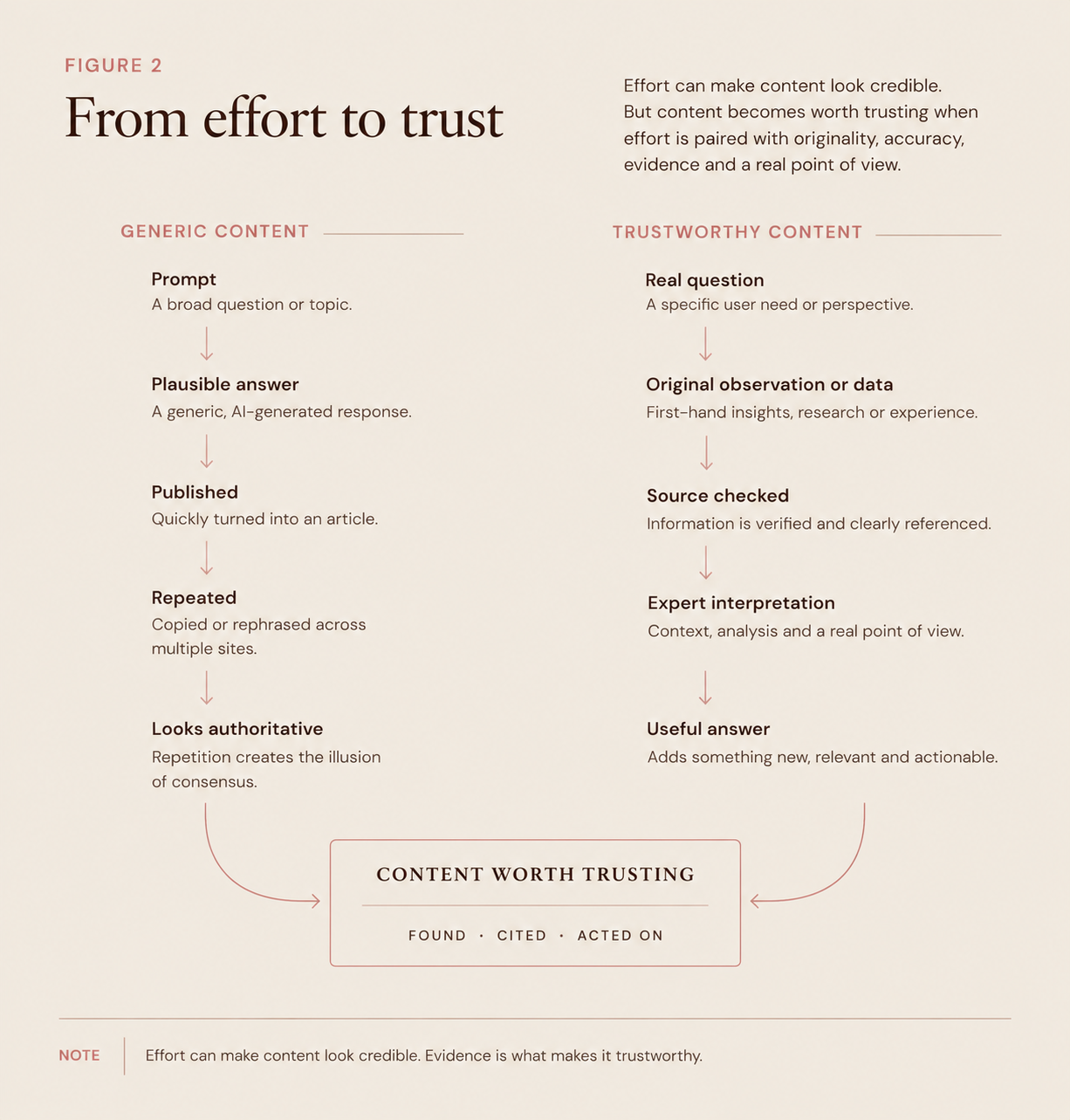
An AI assistant deciding what to cite in an answer is doing something remarkably similar to what contentEffort is trying to measure. It's looking at a handful of pages that all cover the same topic and deciding which one actually adds something the others don't. A page that reads as generic, that could have been produced by prompting an LLM with the same query, gives an AI system no real reason to reference it over the other nine pages saying the same thing in slightly different words.
There's a genuine irony sitting in the middle of this. contentEffort is itself LLM-estimated, built at least partly to detect and de-rank AI-generated content, at the exact moment AI-generated content is flooding both traditional search and the sources AI assistants draw from. The tool designed to spot the shortcut is a mirror of the problem it's responding to.
So regardless of whether Google ever confirms this specific attribute is in active use, the direction is hard to miss: demonstrated effort and originality are becoming the dividing line between content that gets found and cited, and content that gets lost in a sea of pages saying the same thing. That's true for a person deciding whether to trust what they're reading. It's true for a ranking algorithm. And it's true for an AI system deciding what to put in front of someone asking a question.
The gap effort alone doesn't close
There's a problem contentEffort can't solve on its own, and it's worth naming directly: effort and accuracy aren't the same thing.
A page can show every visible sign of effort, original-looking data, a confident expert tone, custom charts, and still be wrong. An LLM estimating effort is grading the shape of the work, not verifying the substance underneath it. That distinction matters more by the month, because a growing share of what's being published is itself AI-generated, and AI-generated content has a well-documented habit of stating things confidently that simply aren't true.
Here's where it gets circular, and a simple example makes it concrete. Imagine an AI tool generates an article claiming "the average conversion rate for X industry is 4.2%," a plausible-sounding number invented on the spot. That article gets published, picked up and rephrased by a few other AI-assisted sites chasing the same topic, and within a few months, that same 4.2% figure is sitting on a dozen pages. None of them cite an original source, because there isn't one. But to a system scanning the web for consensus, or to an AI assistant looking for corroboration before it cites a number, twelve pages repeating the same stat looks a lot like agreement. It isn't. It's one fabrication, copied.
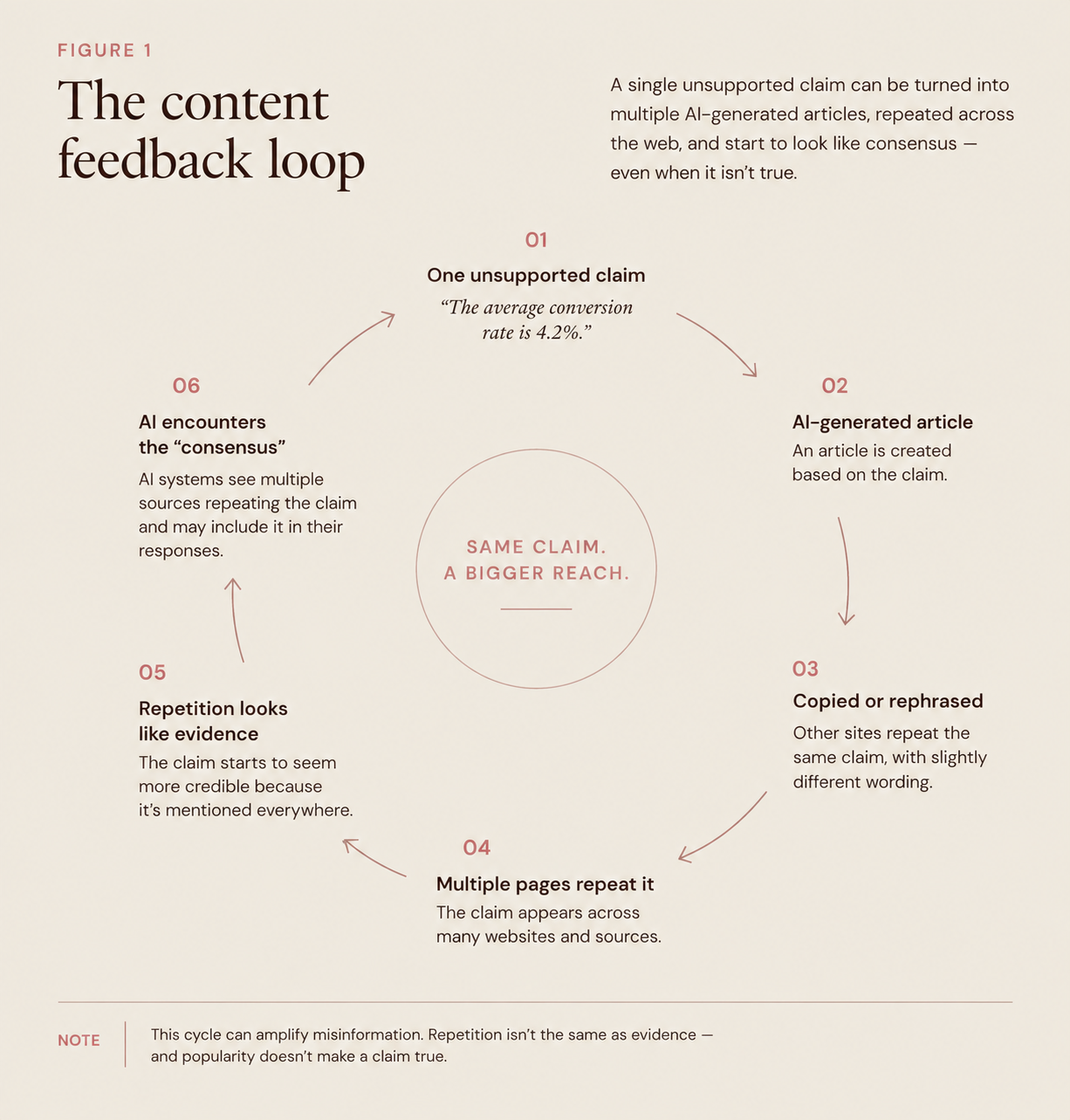
Effort scoring doesn't catch this. A fabricated statistic dressed up with a custom visual can score as high-effort and still be false. This is why I don't think content effort is the whole story, for ranking or for AI visibility. The businesses that come out ahead of this shift won't just be the ones producing effortful content. They'll be the ones whose content is actually accurate, and who can show their work.
What this actually means for your content
A few honest, non-hype takeaways, regardless of what Google confirms or doesn't:
- Original data or a real screenshot beats a restated statistic. If your page's numbers could have come from any other article on the topic, they're not adding anything a machine (or a competitor) couldn't already produce.
- A specific point of view is a form of effort. "Here's what I think, based on what I've actually seen" is harder to replicate than a neutral summary, and it's exactly the kind of thing an AI system has to attribute rather than paraphrase generically.
- Ask the honest question before you publish: could this have been generated by prompting an LLM with the same topic? If the answer is yes, that's worth sitting with, whether or not you wrote it yourself.
- Trace every number back to where it actually came from. If you can't point to the original source of a statistic you're using, don't publish it as fact, and be wary of "everyone else says this too" as verification. Repetition isn't confirmation, especially now that so much of what's being repeated was AI-generated in the first place.
What this means if you're a small business
You don't need Google's marketing budget or an in-house content team to compete on this. If anything, small businesses have a real advantage here: you actually know your customers, by name, not as a keyword-research persona.
Say you're a hairdresser writing "how to look after curly hair between salon visits." You're not competing on volume or domain authority. You're competing on whether the post is actually true and specific to you, things like:
- The products you recommend, because you've actually used them on real clients' hair
- The one mistake you see walk through the door every week
- A seasonal tip nobody else in your area mentions, because nobody else there specialises in curly hair
And that's exactly why it's worth writing, beyond search or AI visibility. A post this specific does some of the selling before a client ever calls: someone who recognises their own hair type and their own frustration in your post already trusts you before they've even booked an appointment. That kind of trust doesn't come from a generic "curly hair tips" article. It comes from a post only you could have written.
An AI tool prompted with "curly hair tips" can't produce any of that, because it doesn't know your clients.
That's also, not coincidentally, exactly the kind of content a search engine or an AI assistant is more likely to reference, because it couldn't have come from anywhere else.
And here's a small bit of proof, hiding in plain sight: if you found this article through a search or an AI assistant rather than a direct link, that's the whole argument working on you in real time. This isn't hypothetical content strategy. It's the same mechanism that just put this piece in front of you.
Start with the audience, not the algorithm
None of this needs a leaked attribute to justify it. It's the same argument I make about website architecture and content strategy generally: the same structure and clarity that helps a person trust what they're reading is what helps a search engine, and increasingly an AI assistant, understand, trust, and reference it. The leak just gave that argument a concrete, nameable example.
But there's a piece that's easy to skip past in all this talk of scores and attributes: the actual work of knowing who you're writing for and what they need. Content effort, in the sense that actually matters, isn't about producing more, or dressing a page up to look thorough. It's about doing the work most businesses skip:
- Talking to your actual customers
- Understanding what they're genuinely trying to figure out
- Looking at your own data instead of assuming you already know
- Building content around a real question instead of a keyword
That's slower than prompting a tool for an article and publishing it. It's also the one thing a generic AI-generated page can't fake, because it requires knowing something specific and true about a specific audience, not just producing something that reads as confident and complete.
Good content has never really been about volume, or even about effort in the abstract. It's about understanding your audience well enough to say something accurate and useful that they can't get from the next ten pages that show up in the same search.
Interested in this sort of content? Subscribe to the newsletter for more like this.
Sources
- 2024 Google Search documentation leak — Wikipedia
- An anonymous source shared thousands of leaked Google Search API documents with me — Rand Fishkin, SparkToro
- Secrets from the algorithm: Google Search's internal engineering documentation has leaked — Mike King, iPullRank
- Huge Google Search document leak reveals inner workings of ranking algorithm — Search Engine Land
- The contentEffort attribute from Google's Content Warehouse leak — Searchable