Google has added a new Generative AI Performance report to Search Console, giving me a clearer view of what happens to my content inside Google's AI search experiences.
As of 31 August 2026, the report has rolled out globally.
You'll find it under Performance → Generative AI, sitting alongside the regular Search results report.
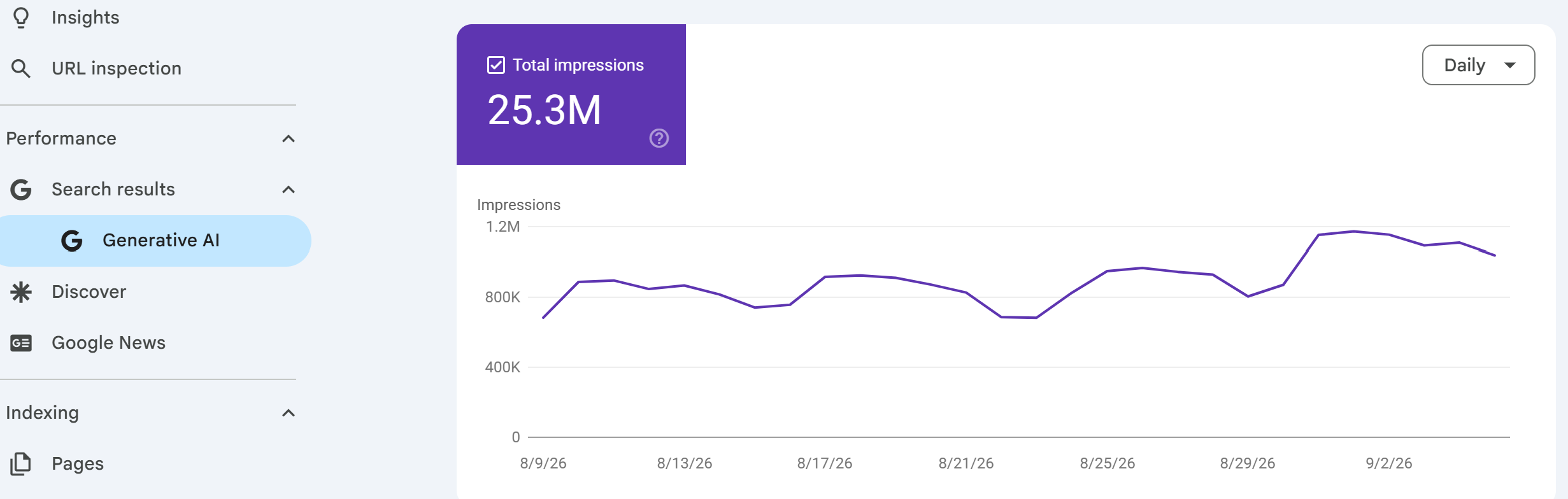
The report covers AI Overviews and AI Mode, and lets you look at impressions over time, by page, country and device.
One important thing: don't add the numbers together
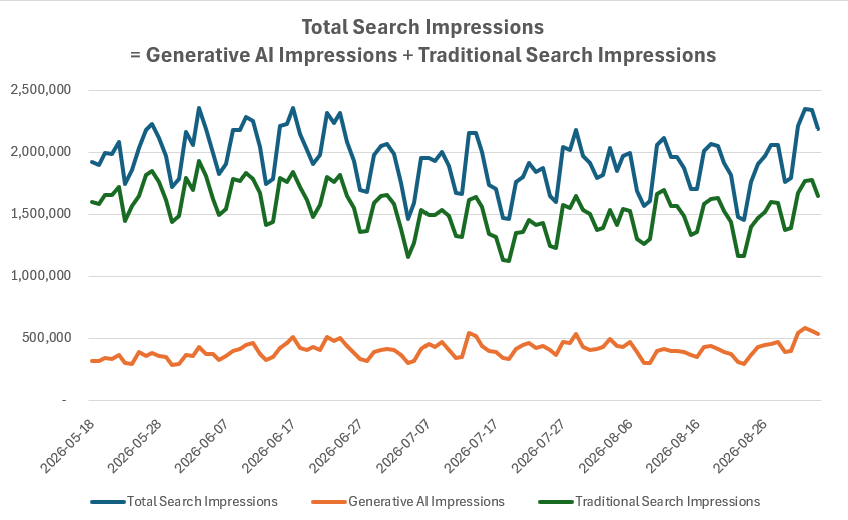
The Generative AI report isn't a separate pool of impressions on top of your organic Search data. Google says the report includes data from the Web search type in the main Search performance report, so the Generative AI figures are a filtered view of impressions that are already included in your overall Search data.
For example, if your site has 100,000 total Search impressions, including 5,000 from generative AI features, your total isn't 105,000. It's 100,000 total, of which 5,000 came from generative AI features.
A small detail, but an important one when interpreting the data.
Worth knowing: there's no historical backfill. The earliest date with data in the report is 18 May 2026 — you won't see anything before that, no matter how far back you set the date range.
That 18 May cutoff only applies to the Generative AI report's impressions, though. Clicks work differently — there's no separate "AI clicks" metric. Any click from AI Overviews or AI Mode has already been folded into your regular Search Console click totals, following the normal Performance report history (around sixteen months back), not the 18 May cutoff. Worth keeping the three straight: total impressions, Generative AI impressions, and total clicks all have different histories behind them.
An impression isn't a citation
Google defines an impression in this report as a link to your site being shown to a user in a generative AI feature on Google Search.
For example, imagine someone searches Google for "best CRM for a small business." Google generates an AI Overview comparing different CRM options, and one of the links shown within that experience points to your CRM comparison page. That counts as an impression for your page. Or someone searches "how much does a CRM cost?" and your pricing guide is surfaced as a link within the AI response — again, your page receives an impression.
And this isn't only relevant to larger businesses. Imagine someone searches "best hairdresser for curly hair near me." Google generates an AI response recommending local options, and a link to a local salon's website appears within that experience. That counts as an impression for the salon's page. The salon can then look at whether its service pages, location pages or useful content are gaining visibility in these searches.
If the user then clicks that link and visits your website, that click is reflected in Search Console's broader performance data. Google confirms that clicks on links in AI Overviews and AI Mode are included in Search Console's Search performance data.
But the impression itself doesn't tell me:
- whether your brand was explicitly mentioned
- whether the page was actually used as a source for the answer
- whether the user noticed the link
- whether they clicked
- or whether that visibility ultimately led to a business outcome
So impressions, citations, clicks and conversions shouldn't be treated as interchangeable metrics.
So what can we actually learn?
Quite a lot, if we treat the report as a visibility signal rather than a complete measure of AI search performance. We can see which pages are receiving the most impressions and filter by country, device and date. I've already started adding this data into reports and audits for clients, and it's genuinely interesting.
Seeing which pages are receiving the most impressions gives us a first glimpse into where content might be gaining visibility in AI search. There's no query-level breakdown, so we don't get the exact questions triggering those impressions, but we can still start spotting patterns: which topics are being surfaced, which products or services are appearing, whether certain offering pages are receiving more visibility than others, and whether there are differences between markets. This could give us an early signal of which subjects, products or offerings Google is finding relevant within AI search experiences.
From SEO insight to broader marketing
And this is where I think the data gets particularly interesting. If a product, service or topic is consistently gaining visibility, that insight shouldn't stay within SEO — it could influence the wider marketing strategy:
- Social — create more content around the questions and themes gaining visibility
- Digital PR — look for opportunities to build authority and contribute to conversations around those subjects
- Paid media — test whether increasing exposure around those themes can reinforce relevance and capture demand
- Content — strengthen the pages already gaining visibility and make sure the content is clear, well structured and genuinely useful
That last point is worth thinking about too. AI visibility isn't only about whether Google can find your content — we also need to think about whether that content is clear, structured and accessible enough for search systems to understand and potentially reuse. So alongside monitoring visibility, there may be value in looking at AI readability: can the important information on a page actually be accessed and understood by AI systems? That doesn't mean every AI-readability score or audit should be taken as gospel — different tools use different methodologies — but the underlying question is useful.
How can small businesses use the new Generative AI report?
Local businesses are an interesting case, because traditional local search and generative AI search aren't quite the same thing.
A search such as "hairdresser near me" will still primarily return local results, including Google Business Profiles and Maps. Google says local results are influenced by relevance, distance and prominence.
But AI Mode opens up a different type of local search. For example, someone might ask: "find a hairdresser near me that specialises in curly hair and has appointments this week." Google says AI Mode can handle local requests such as finding haircuts, auto repair and other home or personal services, and can even check availability or pricing in some cases.
This creates an interesting opportunity for local businesses. The question isn't only "do I rank for 'hairdresser near me'?" It becomes: "does Google have enough useful, accurate information about my business to understand when I might be relevant to a much more specific request?"
That makes the basics particularly important: an accurate and complete Google Business Profile, clear service information, opening hours, location details, reviews and useful website content. Google says it combines information from Business Profiles, websites, third-party sources, user contributions and other sources when building its understanding of local businesses.
And this is where the new AI visibility data could become interesting for local businesses too. If particular service pages start receiving visibility in AI search, that could inform what the business talks about across content, social, PR and paid media — helping build relevance around the services and questions that matter most.
The goal isn't simply to rank for "hairdresser near me." It's to become a business that Google can confidently surface when someone has a specific need.
If you're a local business, this also brings us back to the fundamentals of local visibility. Before worrying about AI search, it's worth making sure Google can clearly understand who you are, what you offer and where you operate. I've put together a practical guide on exactly that: Getting Found on Google Business Profile.
Visibility doesn't always mean impact
This is where the measurement conversation gets more interesting. We're moving from a relatively familiar SEO model — impression → click → session → conversion — to something much less straightforward: AI visibility → citation/mention → click → consideration → conversion. These are different signals, and understanding how they relate to each other, and ultimately to business outcomes, is going to be one of the interesting challenges of measuring AI search.
Importantly, click data isn't completely absent. Clicks from AI Overviews and AI Mode contribute to the regular Search Console Performance report, even though the new Generative AI report itself focuses on impressions. That means we need to be careful about what conclusions we draw from the new report. An increase in AI impressions is interesting, but it isn't automatically an increase in demand, and an increase in visibility isn't automatically an increase in revenue.
Should you include your site in Google's Generative AI features?
For most websites, I'd say yes. The default setting is already Include, and Google says this allows your content to appear in AI Overviews, AI Mode and other supported generative AI features. You can also opt out if you decide that appearing in these features isn't right for your business.
My approach would be: Include → Measure → Learn → Decide. I'd rather understand what is happening before opting out of an emerging search surface. If the data eventually shows that AI visibility is creating little value, that's a strategic decision you can revisit — but first, you need the data.
Interested in this sort of content? Subscribe to the newsletter for more like this.
The bigger opportunity
I think the real opportunity here is bigger than simply asking "how do I get my website into AI answers?" The more interesting question is: what does the visibility I'm gaining tell me about what people are looking for, and how can I use that insight across the rest of my marketing?
Because AI search may become another source of audience and intent signals. The pages receiving impressions can tell me where visibility is emerging. The markets receiving those impressions can tell me where relevance may be growing. And the topics behind that visibility can potentially inform what I create, promote and talk about across SEO, content, social, PR and paid media.
Ultimately, the goal isn't just to appear in more AI answers. It's to turn that visibility into relevance, consideration and, eventually, business outcomes. And I think we're still very much at the beginning of figuring out how to measure that journey.
One last thing: there's a separate version of this report for Discover too. I haven't had the chance to dig into that side of things yet, so I'll come back to it separately if there's anything worth adding once I have.
Sources
- Google Search Console: Generative AI performance report
- Google Search Console: Search generative AI control
- Google Search Console: Impressions, position and clicks
- Google: How local results are determined
- Google: Use AI Mode to check local availability and pricing
- Google: How Google sources & uses info in Business Profiles & local search results